Camper van conversions
We turn a van into a living vehicle: insulation, interior layout, furniture and storage, power, water, air conditioning and equipment. In a van you own, or one we source for you.
What a conversion covers
Heat insulation
Insulation and window covers chosen for UAE summers, before any furniture goes in.
Layout and furniture
Fixed or folding beds, seats, a kitchen and storage arranged for the way you travel.
Power and cooling
Lithium batteries, solar and charging sized to run the air conditioning when you need it.
Water and bathroom
Fresh and waste water, a shower and toilet if the van has room for them.
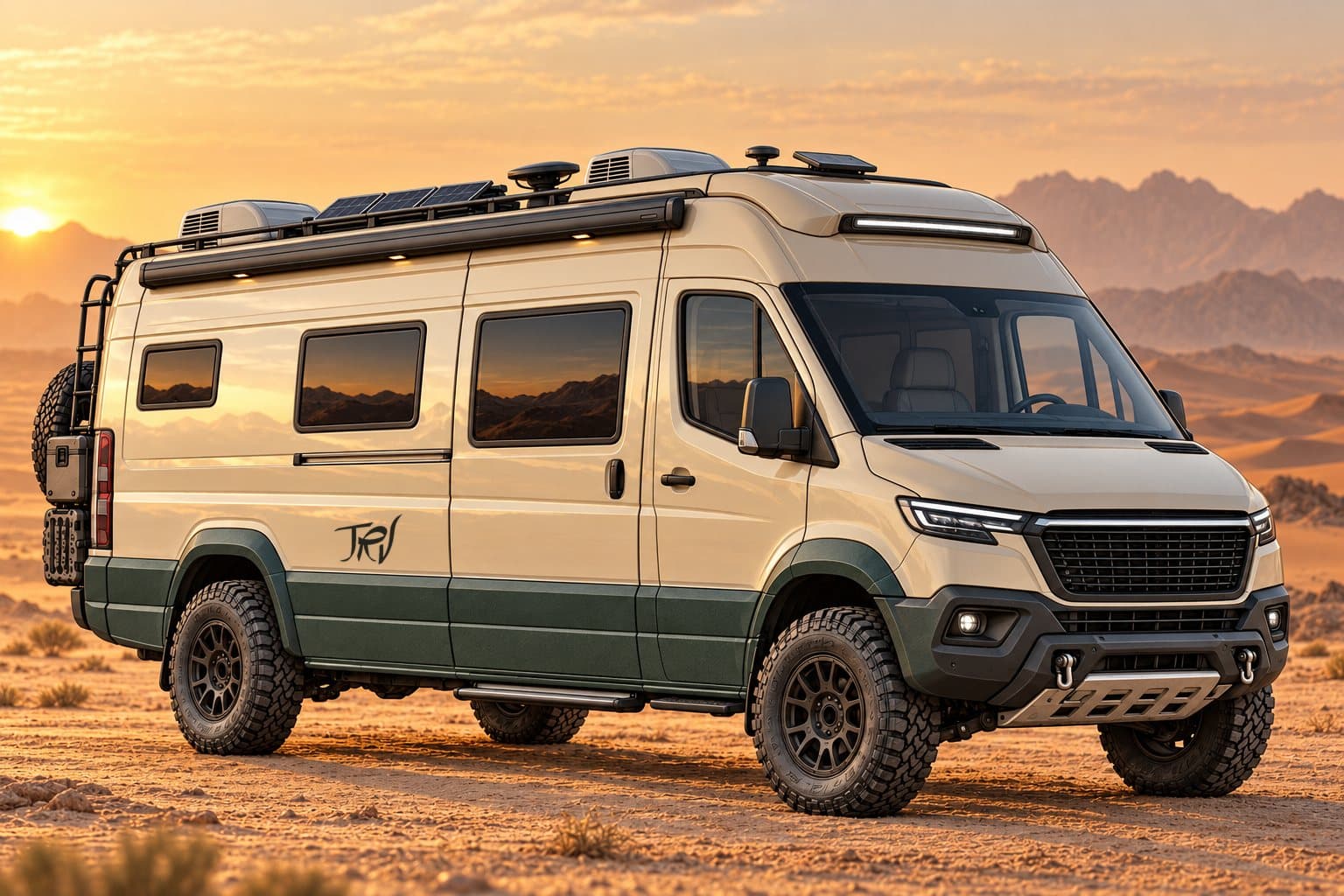
Concept illustrations
How we picture this kind of build. These are drawings, not photos of a delivered unit; every project is designed to its owner.
01 / 07
Specification options
What TRV can design and build into a compact, standard or extended van, 2WD or 4x4, with a high roof or a pop-top. Each group starts with its most advanced option. All values are typical ranges.
Body & structure
5 options
- Fibreglass parts from TRV's workshop
- Side flares that make room for a transverse bed (about 10–15 cm per side), plus roof fairings and door surrounds, all insulated like the body.
- Fibreglass high roof or pop-top
- A foam-cored fibreglass roof giving about 1.9–2.0 m of standing height, or a pop-top that adds about 0.6–1 m of headroom and an upper bed.
- Rear garage with pull-out slide
- An insulated garage with dust seals under a fixed or lift bed, with a slide for bikes, sand boards and recovery gear.
- Rear barn doors with carriers
- Doors that open about 180°, or about 270° on a door with no carrier, with a bolt-on aluminium ladder and a spare-wheel or box carrier, usually fitted without drilling the door skin.
- Flush or framed insulated windows
- Flush-bonded tinted glass, or framed double-glazed tinted acrylic windows with built-in blinds and insect screens.
Insulation & climate
6 options
- Battery-powered roof air conditioning
- One or two variable-speed DC units running from the battery, each giving about 2–3.5 kW of cooling and drawing about 0.3–1.4 kW. Running on DC avoids inverter losses.
- Heat-pump mode for winter nights
- Where the unit has a heat-pump mode, it also heats at about 2.5–3 kW, with no fuel heater, flue or exhaust.
- Insulation with reduced thermal bridging
- Thermal breaks on the ribs, rigid foam on flat panels, non-absorbent fibre in cavities and a breathable approach to coastal humidity.
- Under-bed ducted air conditioning
- An alternative to a roof unit: about 2–2.5 kW of cooling through ducts, running on 230 V through the inverter. It keeps the roof free for solar; outside air vents are filtered against sand.
- Covers and door curtains
- Insulated reflective covers for the windscreen and windows, plus a climate curtain that keeps the cool air in while the doors are open.
- Thermostatic roof fan
- Clears trapped heat before the AC starts. Fitted with a rain shield and fine mesh against sand and insects.
Power
5 options
- 48 V house electrical system
- About a quarter of the current of a 12 V system for the same power, so cables are thinner and run cooler. A converter keeps 12 V lights and pumps working.
- Lithium (LFP) battery bank
- About 4–8 kWh, or about 10–17 kWh for AC overnight; how long the AC runs depends on the night temperature, setpoint and insulation. Charging adjusts to battery temperature, and the bank sits inside the cooled zone.
- Charging while driving
- One or more DC-DC chargers suited to a 48 V bank (about 0.5–1 kW each), installed in a ventilated spot, or a second 48 V alternator (about 3 kW and up) with a temperature-sensing regulator, where a mounting kit exists for the base engine.
- Inverter/charger
- About 3–5 kVA pure sine wave at 230 V/50 Hz. It switches to shore power automatically and is sized for its hot-weather rating.
- Roof solar with MPPT control
- About 500–900 W on a large roof, less when two roof AC units share it. Ventilated mounts, set apart from the AC units to limit shading, top up the battery by day.
Kitchen, water & bathroom
6 options
- Protected drinking water
- An insulated tank low between the axles, sediment and carbon filters, and UV-C LED treatment at the drinking tap.
- Gas-free electric galley
- Induction hob with one or two zones, a compressor fridge of about 90–150 L and a microwave or combination oven. No gas cylinders in hot lockers.
- Space-saving wet bath
- Slide-away toilet, fold-flat basin and roll-up shower door, in moisture-resistant composite panels.
- Electric hot water
- A heater element of about 1–2 kW (up to about 3 kW in some combined units) running from the battery, or a hybrid fuel/electric unit as winter backup.
- Recirculating showerEmerging
- Filters and UV-treats the shower water in a loop of about 6 L. The filters need regular care.
- Outdoor shower
- A hot and cold outdoor shower at the rear for rinsing sand off people and gear.
Smart control & connectivity
6 options
- TRV smart control
- TRV's own system: KNX control, DALI dimmable lighting inside and out, a touch screen, a phone app and an energy-flow display.
- AC energy guard
- Automation rules on a CAN network switch the AC down to ventilation before the battery runs low.
- Remote monitoring
- Battery charge and temperature, tank levels and cabin temperature on your phone while the van stands in the sun.
- 5G dual-SIM router
- A roof MIMO antenna, automatic switching between two SIMs and Wi-Fi throughout the cabin, where mobile coverage exists.
- Satellite internetEmerging
- A flat roof terminal, where UAE service plans allow. It is rated to about 50 °C, so it may slow down or pause around midday in summer. Plan availability for mobile use in the UAE is still limited.
- Voice control through MatterEmerging
- TRV's Matter bridge links lights and climate to common voice assistants through a compatible smart speaker or hub. Energy features for vehicles are still early.
Safety & security
4 options
- Battery-bay fire protection
- A battery enclosure sealed from the cabin and vented to the outside, with smoke, heat and gas detection and an automatic aerosol suppression unit to help contain a fire.
- Camera visibility
- A camera rear-view mirror and 360° surround view, with sealed, dust-resistant cameras.
- Smoke and CO alarms
- A smoke alarm in the living area and a carbon-monoxide alarm, recommended in every build and essential with any fuel-burning appliance.
- Cellular alarm
- A 4G hub with motion and door sensors that sends alerts to your phone. There is no monitoring-service fee; it uses its own standard mobile SIM.
Running gear & off-road
6 options
- Air suspension
- Auxiliary rear air springs or full air suspension, where a kit exists for the chosen base, with ride-height control and levelling. Air lines are protected from sand.
- Hydraulic levelling jacks
- Four legs level the parked van from a button or the app, where a kit exists for the chosen base. They are mounted to keep ground clearance, use wide pads for sand, and the system weighs about 70–80 kg.
- 4x4 or AWD base
- A 4x4 or all-wheel-drive van on all-terrain tyres, with underbody protection.
- Weight and balance plan
- Batteries and water sit low between the axles, roof equipment stays light, and lightweight furniture saves about 50–100 kg.
- Desert pack
- An on-board air compressor to deflate and reinflate the tyres, and sand boards on the rear carrier.
- Electrified base vanEmerging
- A plug-in hybrid or electric base that also powers the living area, where a suitable model exists. Driving range drops when the AC is used.
These are options, configured for each project after we assess the van and how you will use it. There are no prices here: each build gets a written quotation against its agreed specification. Values are typical ranges, not guarantees, and items marked emerging are still early in the market.
Design your camper van
Choose what you need step by step. At the end you leave your details and we send a quote against your choices.
Step 1 of 9
Tell us about your project
Sending a request is free and commits you to nothing. We reply by phone or email.