Motorhomes built to order
A motorhome drives itself: the living space is part of the vehicle. We engineer and build the living body and complete the fit-out on a suitable base vehicle or chassis. We do not make the engine or the base vehicle itself.
Types we build
Compact motorhomes
Van-based or short coachbuilt layouts for two, with a kitchen, bathroom, power and water sized to the space.
Large & luxury motorhomes
More room and equipment for families and long trips, with furniture, finishes and systems to your order.
Coachbuilt bodies
A custom living body built and fitted on a suitable chassis, in compact or larger, low or streamlined designs.
Expedition & 4x4 builds
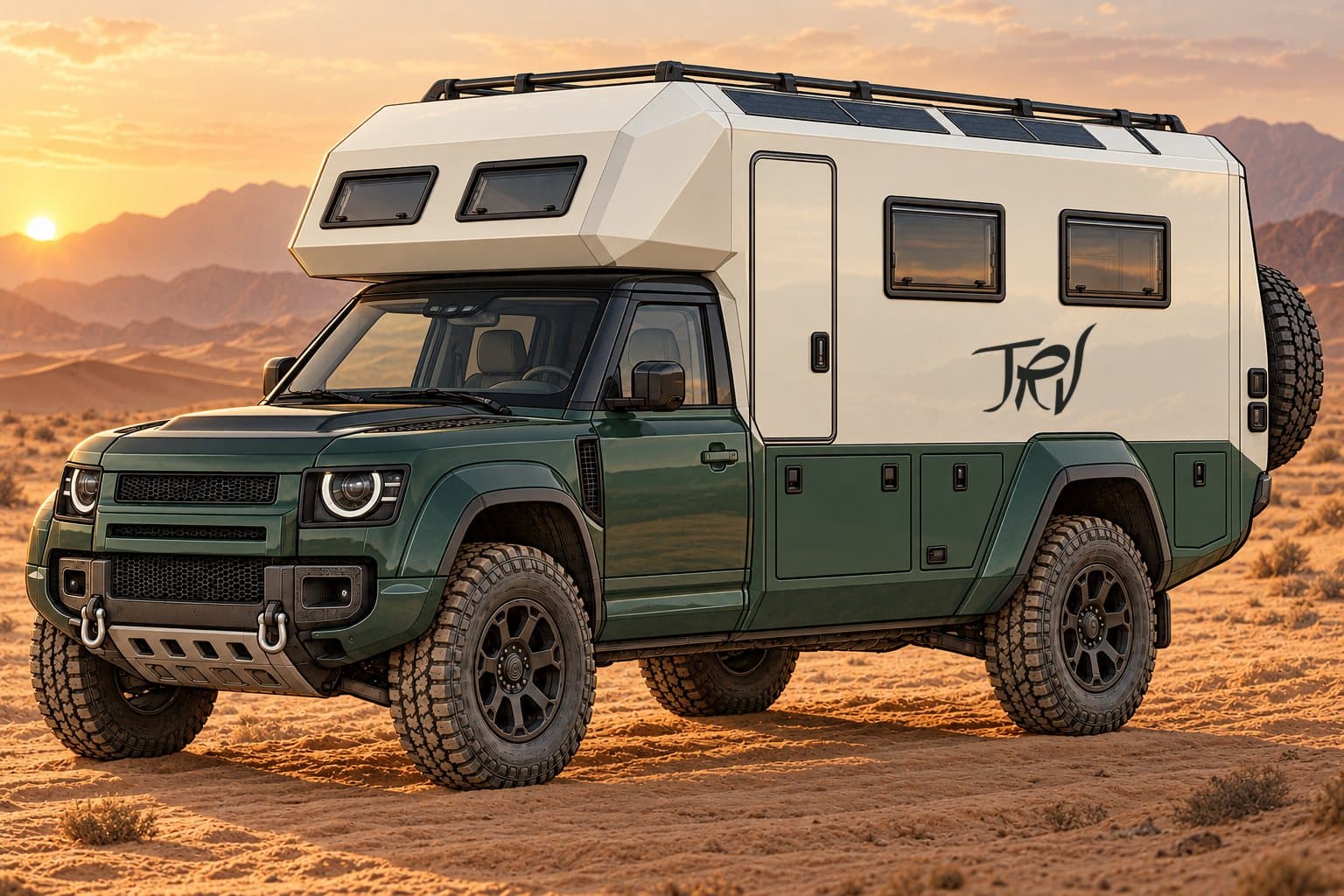
Living bodies and fit-outs for trip vehicles, set to the vehicle and the way you will use it. Our Defender build is one of these.
Concept illustrations
How we picture this kind of build. These are drawings, not photos of a delivered unit; every project is designed to its owner.
01 / 07
Specification options
What TRV can design and build into a motorhome, from compact and expedition 4x4 builds to large luxury bodies: proven options and the newest 2026 technology, each chosen for UAE heat, dust and long distances.
Body & structure
6 options
- Fibreglass sandwich body
- Fibreglass outer and inner skins bonded to a closed-cell foam core for walls, roof and floor; about 40–60 mm for hot-climate builds.
- Moulded front mask and rear wall
- Large fibreglass mouldings made in our workshop, the front mask designed around a bought-in laminated windscreen; vacuum infusion as an option for even thickness and fewer voids.
- Timber-free rails
- High-density PU rails or aluminium profiles set inside the foam core around the openings, bonded and screwed: fixing points with no wood to rot in coastal humidity.
- Thermal-break joints
- Insulated profiles where roof meets wall and wall meets floor, cutting heat paths and condensation spots.
- Insulated double floor
- About 20–45 cm deep between the axles for tanks, a sealed battery bay and through-loading storage, keeping the centre of gravity low.
- One-piece composite living shellEmerging
- Body and roof moulded as one seamless shell; early at this length and heavy on tooling.
Doors, windows & lighting
6 options
- Cab door, then entry door
- Cab doors on both sides are bought-in automotive door units; the living-area entry door sits directly behind the co-driver's door, with a stiffened pillar between.
- Insulated entry door
- Foam-filled leaf about 30–50 mm, multi-point lock, triple seals, fly screen and a tinted double-glazed window.
- Electric step and keyless entry
- Two-stage electric step with light and a warning if it is still out when driving off; fingerprint reader and remote central locking.
- Flush tinted windows
- Double acrylic in a PU frame, or frameless tempered glass that resists sand abrasion better.
- Garage and locker doors
- Garage under the rear bed with doors on both sides; insulated, centrally locked locker flaps. The battery bay is reached from inside, not through an outside flap.
- Full-LED exterior lighting
- Front light signature, full-width rear light bar, entry, awning and garage lights, sealed against dust.
Insulation & climate
6 options
- UAE heat package
- Thicker closed-cell core, a light body colour with dark accents only, reflective blinds on sun-facing glass and an electric awning for shade.
- Electric windscreen shade
- Insulated pleated shade for the panoramic windscreen, the largest glazed area and a major source of heat gain; can link to smart control.
- Two heat-pump roof ACs
- Variable-speed units mid and rear, the mid one over the galley, clear of the drop-down bed; about 2.5–4.4 kW cooling each, chosen from units designed for high ambient (about 46–50 °C); capacity falls as outside temperature rises. Heating for cool desert nights.
- 48 V DC roof AC
- Runs straight from the 48 V battery, skipping the 230 V inverter stage and its losses; about 2.9–3.2 kW cooling, and some units are designed to work in up to about 50 °C ambient.
- Quiet split AC for the bedroom
- Compressor in a sand-protected condenser locker with open grilles for free airflow; indoor unit about 20–30 dB(A) on low fan.
- Zoned overnight cooling
- Bathroom doors close off the rear suite, so only one AC zone needs to run through the night.
Power
7 options
- 48 V lithium (LFP) house bank
- About 18–24 kWh, more on request, modular under one BMS. Fitted in a sealed bay in the insulated double floor with ducted cool air from the AC, not behind an exterior locker hatch, and away from outside lockers that can pass 50 °C in summer.
- Overnight AC on battery
- Planned for one AC zone through the night; overnight AC runtime depends on battery size, outside temperature and recharge from driving or shore power.
- Second 48 V alternator
- About 3–6 kW of charging while driving, the main daily source on long desert legs; subject to the chassis maker's rules.
- Roof solar with MPPT
- Rigid high-efficiency panels on an air gap, about 0.6–1.5 kW on a 9 m roof; output falls in heat and dust, and on its own it cannot keep up with daytime AC in summer.
- 48 V inverter/charger
- About 5–10 kVA pure sine, automatic transfer, and battery boost for weak shore or generator supplies.
- All-in-one power unit
- Charger, DC-DC and solar control in one unit, with app monitoring of the main energy flows.
- Sodium-ion house batteryEmerging
- Lithium-free option with good thermal stability but lower energy density; current RV models are mainly 12/24 V, so it suits a lower-voltage auxiliary circuit or secondary bank unless 48 V packs are confirmed for the project. Early technology, on request.
Water, kitchen & bathroom
6 options
- Tanks inside the insulated floor
- Fresh water about 150–200 L or more, kept off the hot underbody, with grey and black water tanks alongside.
- UV-C and carbon water treatment
- Chemical-free UV-C disinfection at the pump outlet plus a carbon filter, about 2–16 L/min, low power draw.
- Recirculating showerEmerging
- Filters, disinfects and reheats shower water in a closed loop; a niche technology with few suppliers, and makers claim up to about 90 % water saving; needs regular filter care.
- Electric water heater
- About 8–10 L, heated from the battery or 230 V, with an optional engine-heat exchanger.
- Gas-free induction galley
- Two-zone induction hob, convection oven or microwave and a large compressor fridge, all on the 48 V system.
- Water from airEmerging
- Atmospheric water generator, up to about 30 L/day in humid coastal air and much less inland; experimental option. High power use, roughly several hundred Wh per litre, so realistic mainly on shore power or surplus solar.
Layout & interior
6 options
- Face-to-face lounge
- Two facing benches around a table, with the swivelling cab seats joining in; suits majlis-style gatherings.
- Electric drop-down bed
- About 1.3–1.4 × 1.9 m, stowed against the ceiling over the lounge by day, where no roof units sit; sleeps 4 people with the rear bed.
- Full-width bathroom
- Shower with a glass screen and a separate toilet, with doors that close off the rear suite.
- Rear suite over a garage
- Island bed about 1.4–1.6 × 1.9–2.0 m, or twin beds, raised over the garage, with full-height wardrobes.
- Residential finishes
- Mineral-composite worktop, real-wood veneer, frameless fronts, ambient LED and acoustic panels, in heat- and UV-stable grades.
- Electric slide-out
- About 2–3.5 m long, extending about 0.4–0.6 m in this design; an option only, since a fixed body copes better with sand.
Smart control & connectivity
5 options
- TRV Command smart control
- Our own system, built on KNX and DALI standards: dimmable lighting, touch screen, phone app, energy-flow display and a Matter bridge for voice assistants.
- Pre-cool from the phone
- Start the AC, check battery and tanks and get alerts remotely over a mobile or satellite link.
- Vehicle data bus
- CAN / RV-C links for tanks, battery, levelling, water heater and AC, shown on one panel.
- LEO satellite internet
- Flat roof terminal; compact units draw about 25–40 W, larger flat in-motion terminals considerably more. New in the UAE: vehicle-use plans and capacity are checked for each customer.
- 5G roof antenna and router
- Low MIMO antenna that works on a fibreglass roof, with on-board Wi-Fi.
Safety & running gear
5 options
- Base chassis to suit the build
- Chosen per project: a low-frame or light-truck chassis supplied without a cab (cowl chassis), with twin rear wheels for this size; we build the body, not the base vehicle.
- Hydraulic levelling
- Four legs level the vehicle automatically in a few minutes, with sand pads, and integration with air suspension where the chassis has it.
- 360° cameras and blind-spot radar
- Bird's-eye view for fuel stations and farm gates, radar warnings on both sides, in sand-resistant housings.
- Connected detectors and alarm
- CO, smoke and air-quality sensors (plus LPG if a gas appliance is chosen), door and motion alarm, with alerts to the phone.
- Battery-bay fire suppression
- Automatic condensed-aerosol units in the sealed battery bay and technical compartments, heat-triggered with no power needed; they suppress flames but do not replace a good BMS, cell choice and venting.
Every item is an option, configured per project with the customer; none is standard equipment. Values are typical ranges, not guarantees or tested results. Weight, payload and the licence category needed are checked for each build. We build the living body and fit-out on a suitable chassis; TRV does not make the engine or the base vehicle. There are no prices here: each request is quoted against its specification.
Design your motorhome
Choose what you need step by step. At the end you leave your details and we send a quote against your choices.
Step 1 of 8
Tell us about your project
Sending a request is free and commits you to nothing. We reply by phone or email.