Marine projects
The engineering, composite work and systems integration behind our vehicles also apply to boats. We take on custom marine builds and fit-outs, and our own 45 ft project is in progress.
What we take on
45 ft sport cruisers
A hardtop sport coupe with two cabins, a central lounge and galley, and decks set to the owner's use.
Sport jet boats
Smaller boats for day trips and water sports, with seating, shade, audio and towing equipment.
Fit-outs and refits
Interiors, systems and air conditioning for an existing boat.
Our 45 ft project
In progress. We will publish its details as each stage is confirmed.
Concept · built to order
Our boats
TRV 45 Hardtop
A low hardtop open to the sky, two cabins below
 Illustration
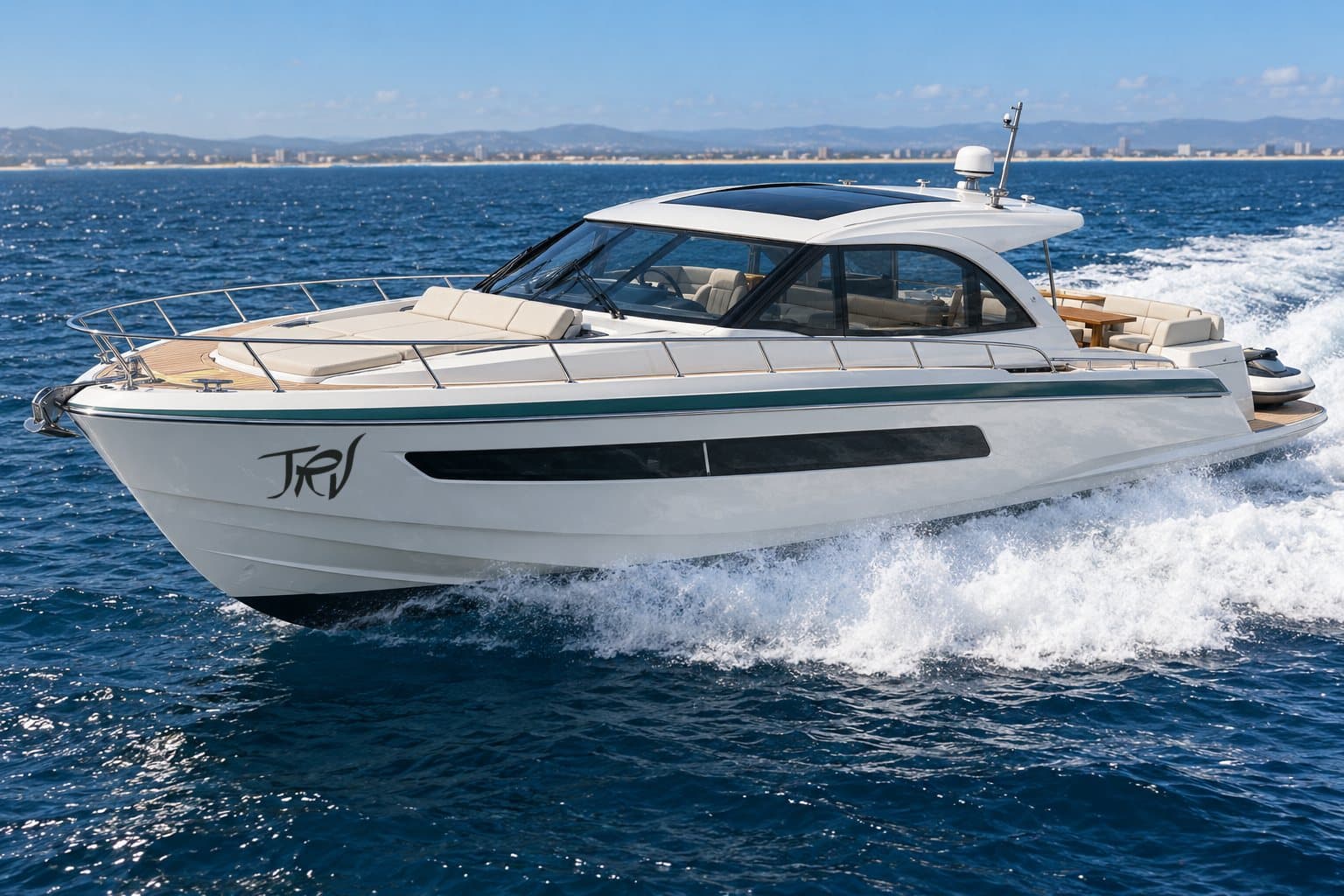
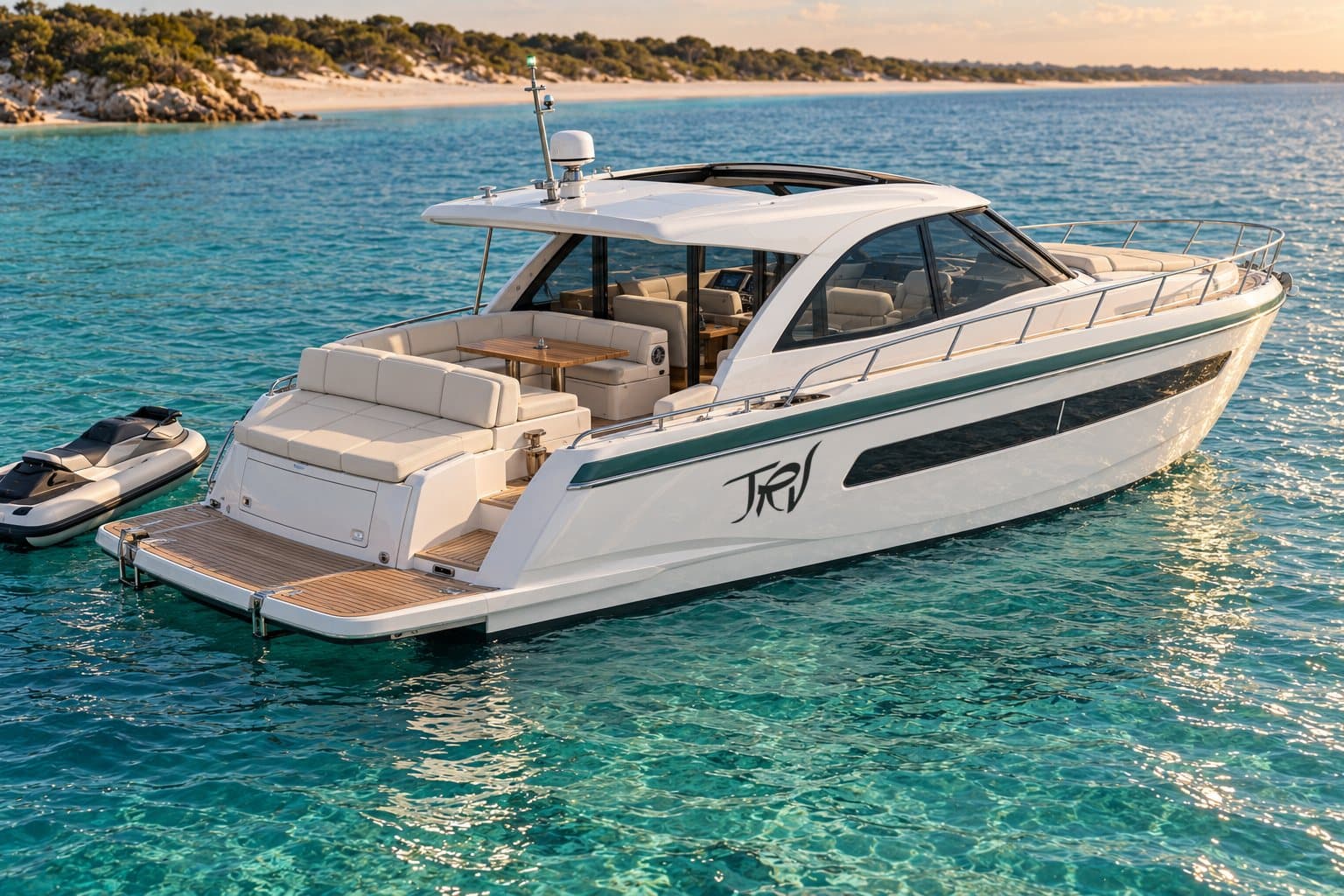
An original TRV concept for a 45 ft hardtop sport cruiser: one level from cockpit to helm, a sliding sunroof overhead, two cabins below and twin diesels on pod drives. Built to order in fibreglass.
 Illustration
Exterior
Sleek and low
A low hardtop over a pearl-white hull with a deep green stripe along the sheer. Side decks lead to a bow sun pad; aft, a sun pad and a hydraulic swim platform for a small jet tender.
 Illustration
Interior
Light above, space below
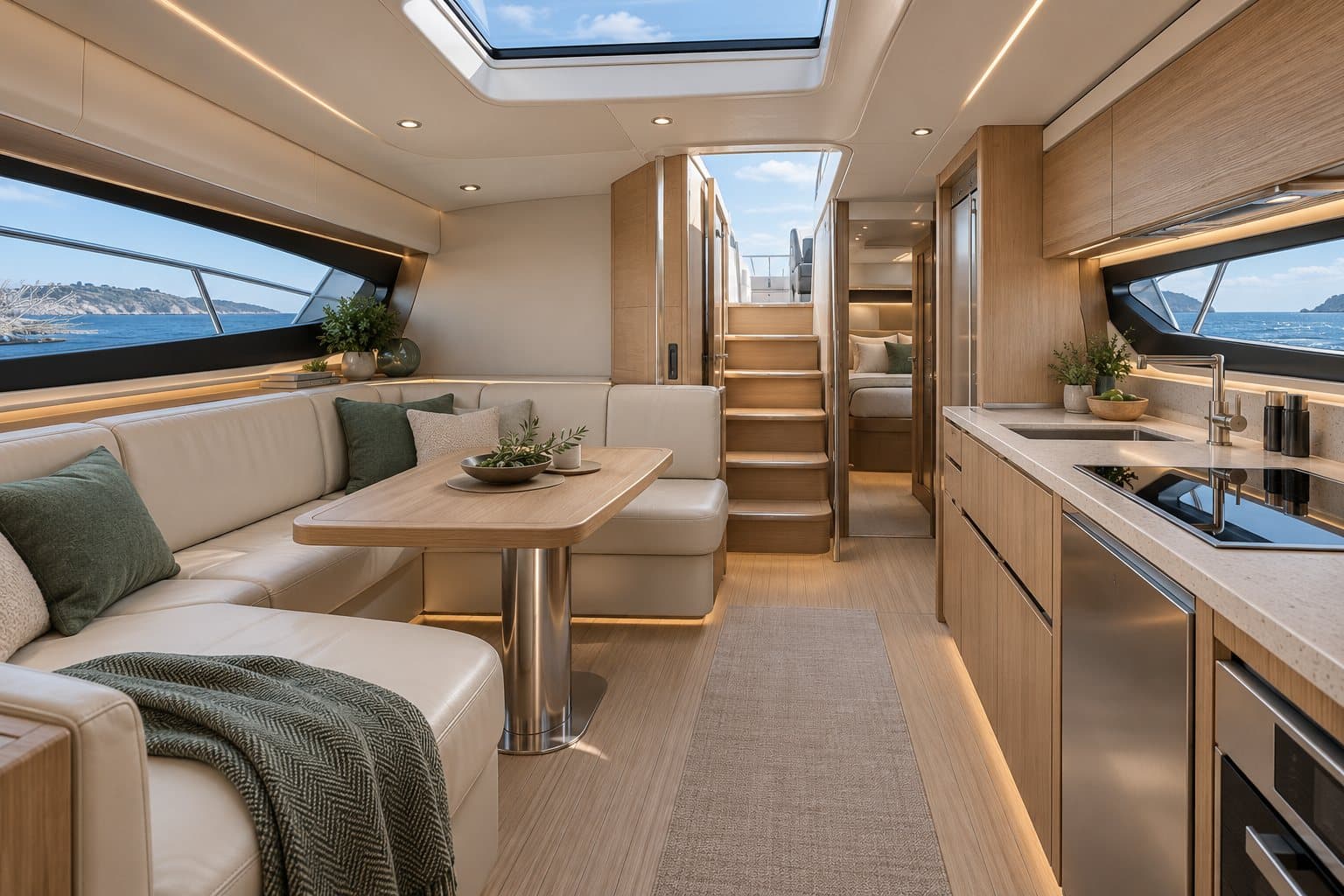
On deck: a double helm seat, an L-shaped lounge and a wet bar, with a sliding sunroof over the helm area. Below: a lounge with dinette and galley, an en-suite owner's cabin, a twin guest cabin and a second bathroom.
General arrangement
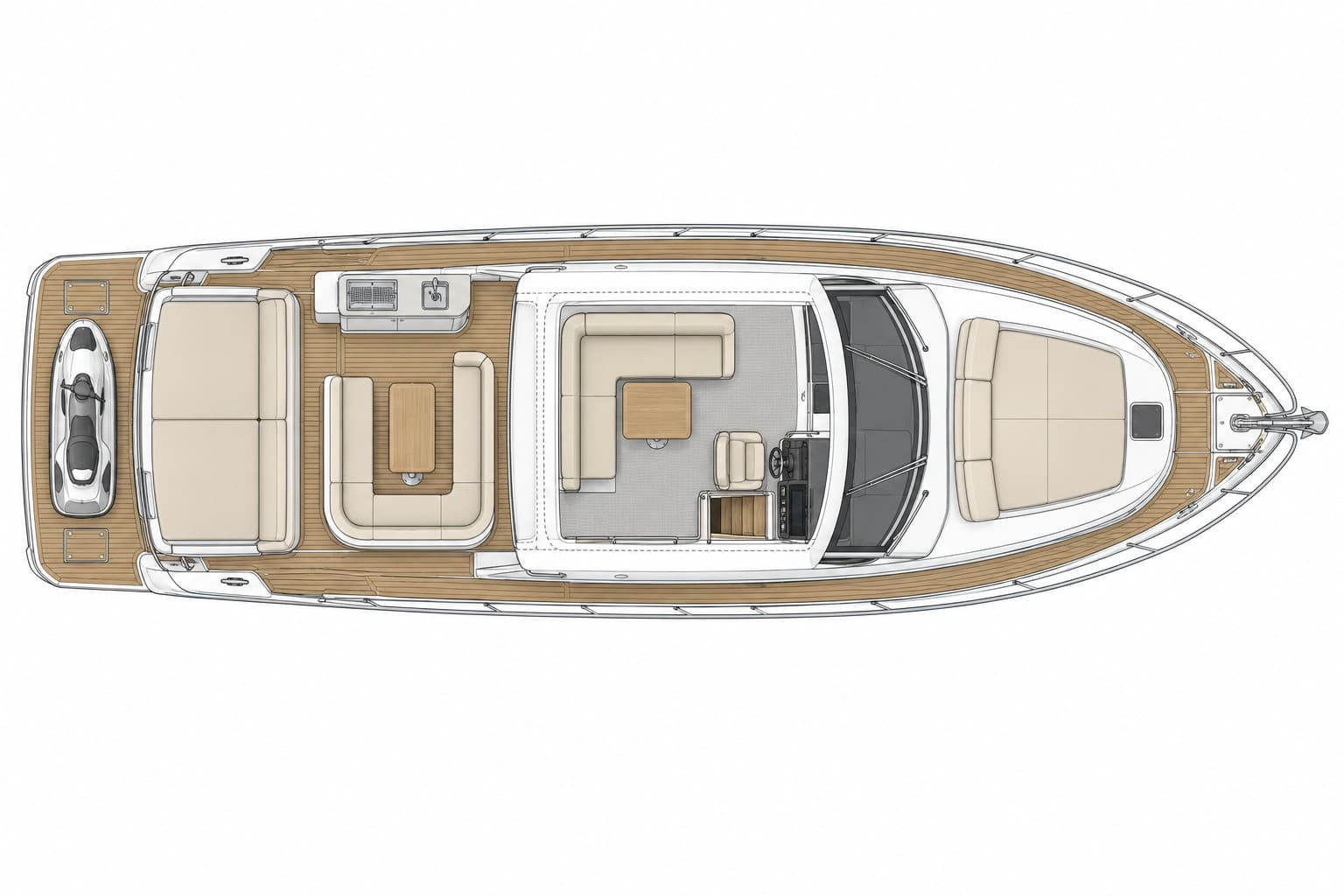
- 1Bow sun pad with folding backrest
- 2Walkaround side decks
- 3Helm to starboard, stairs down beside it
- 4L-shaped lounge with table to port
- 5Wet bar with grill and sink
- 6Cockpit U-sofa around a teak table
- 7Aft sun pad and swim platform with a small jet tender
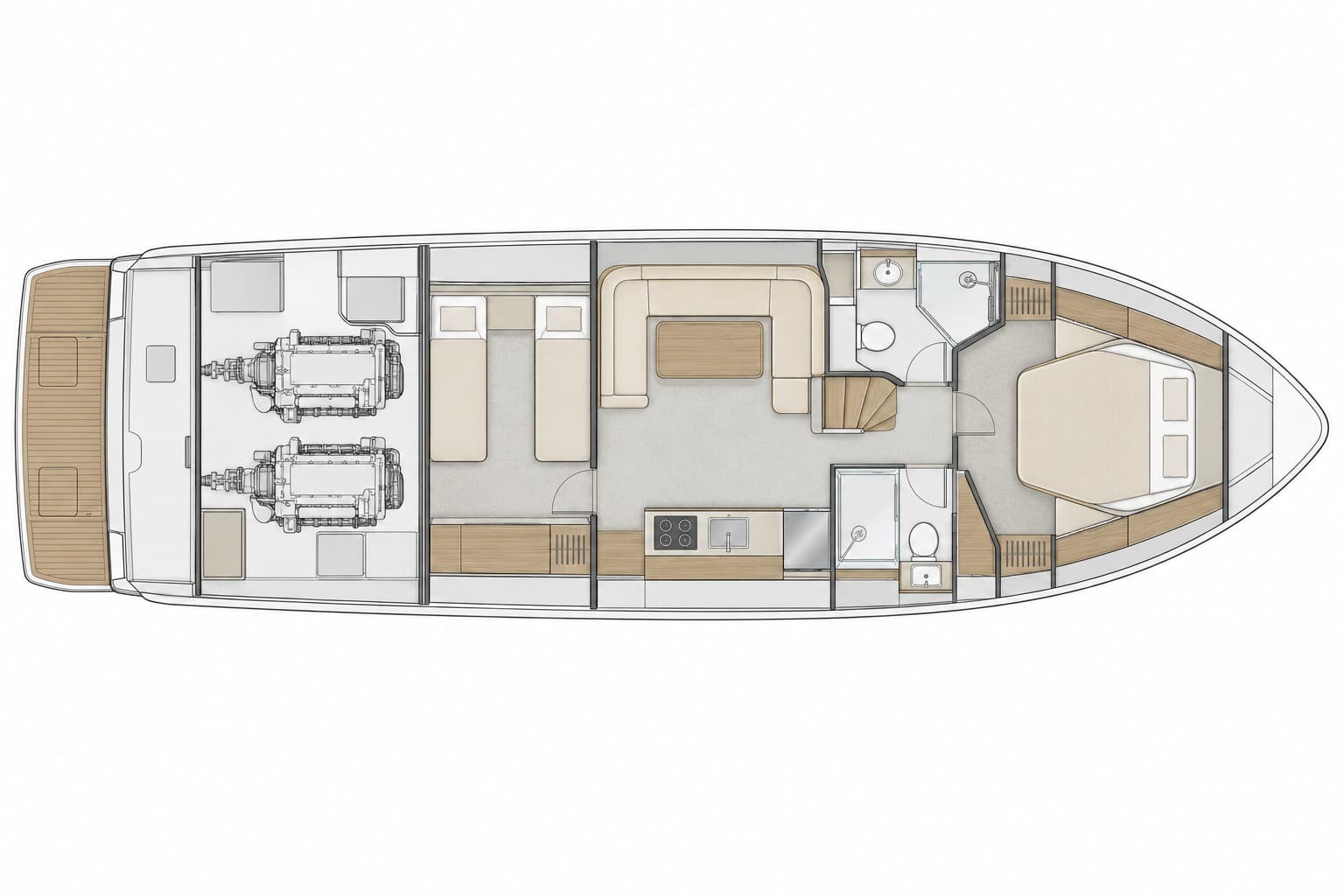
- 1Owner's cabin forward with island double bed
- 2Two bathrooms, each with a separate shower
- 3Lounge with U-shaped dinette
- 4Galley opposite: hob, sink and fridge
- 5Guest cabin with two single beds
- 6Engine room with twin diesels on pod drives
Key figures
Main dimensions
- Length overall
- About 13.7–14.3 m (45–47 ft)
- Beam
- About 4.1–4.4 m (13.5–14.5 ft)
- Draft
- About 1.0–1.2 m (3.3–3.9 ft)
- Displacement
- About 13–15 t light, 16–18 t loaded
- Hull
- Fibreglass, modified deep-V
Accommodation
- Cabins
- 2: owner forward, guest midships
- Berths
- 4: island double and two singles that join
- Bathrooms
- 2, each with a separate shower
- Day guests
- About 10–12, confirmed per project
Propulsion & performance
- Engines
- Twin marine diesels, about 330–360 kW (440–480 hp) each
- Drives
- Twin steerable pod drives with joystick docking
- Top speed
- About 30–33 knots, after sea trials
- Cruising speed
- About 24–28 knots, after sea trials
Tanks
- Fuel (diesel)
- About 1,100–1,300 L (290–345 US gal)
- Fresh water
- About 380–450 L (100–120 US gal)
- Holding tank
- About 100–150 L (26–40 US gal)
All figures are indicative and confirmed per project; performance is confirmed only after sea trials.
View the concept slidesTRV sport jet boat concept
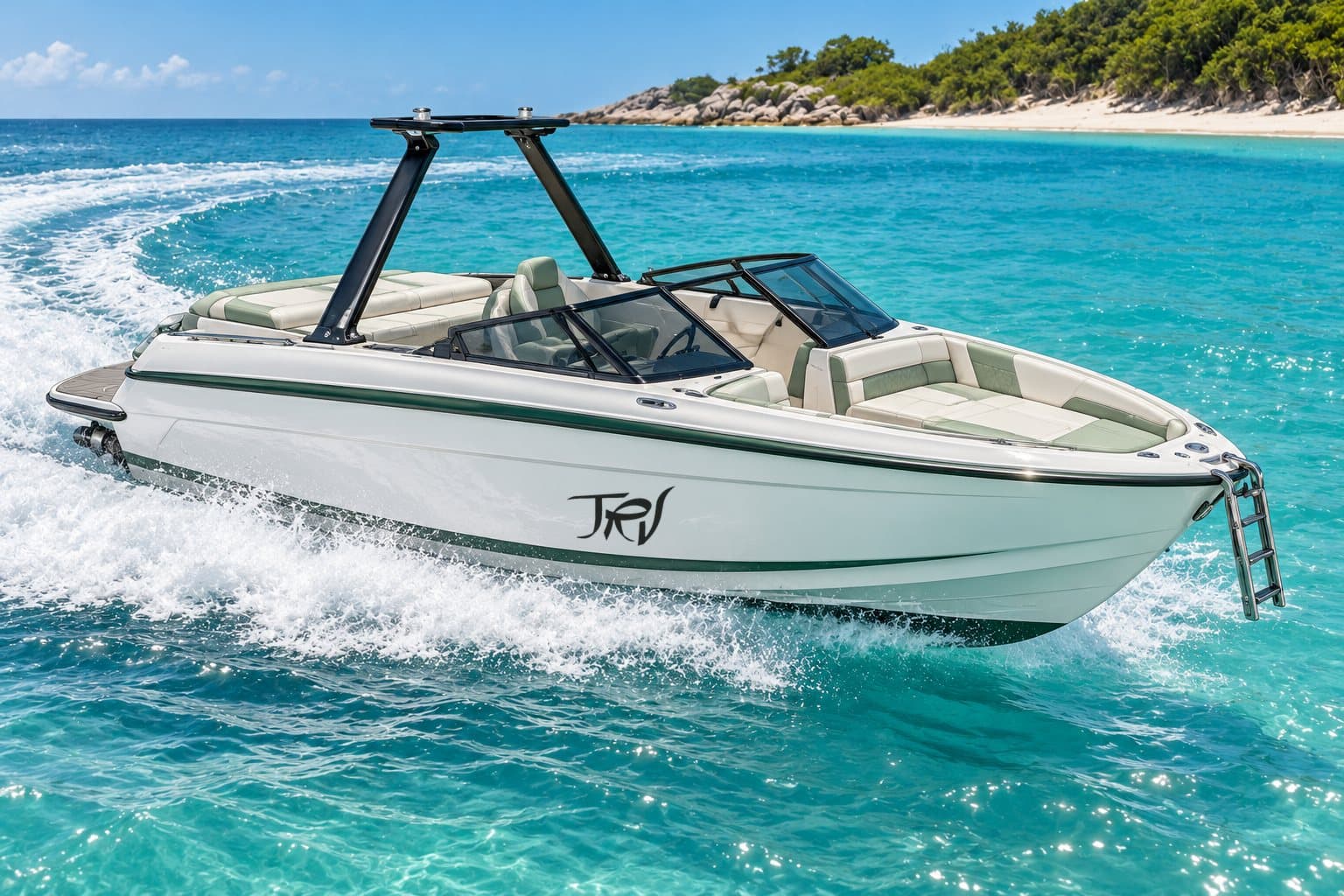
Twin jets, a folding tower, beach-ready
 Illustration
A TRV concept for a twin-engine sport jet boat of about 24–30 ft, for day trips, beach stops and water sports. Its pearl-white hull and accent line match the yacht.
General arrangement
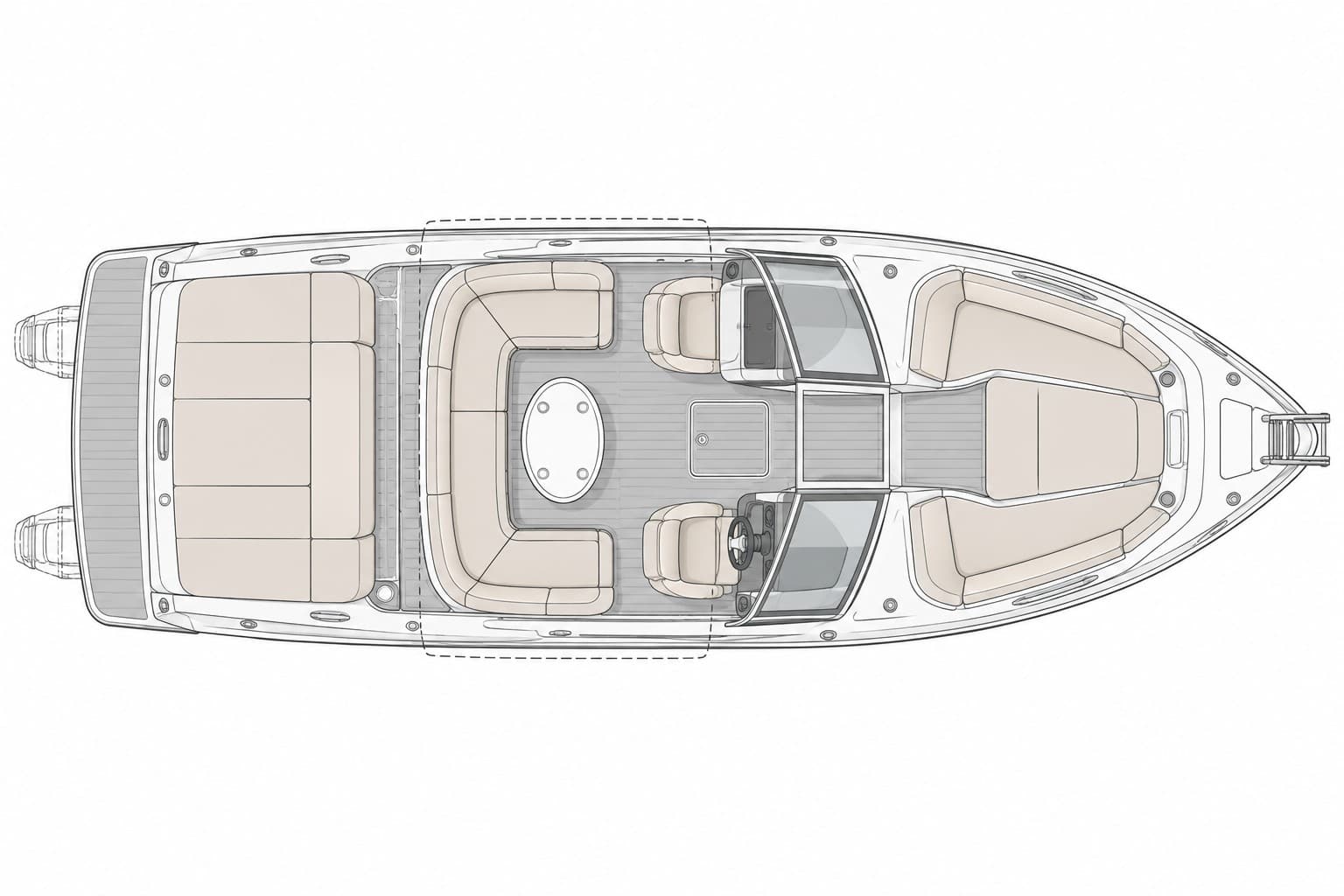
- 1Fold-down bow boarding ladder
- 2Bow lounge with sun pad
- 3Walk-through windscreen
- 4Starboard helm, port companion seat
- 5Wraparound seating under the folding tower
- 6Rear sun pad over the engine bay
- 7Swim platform and twin jet nozzles
Key figures
Main dimensions
- Length overall
- About 7.3–9.1 m (24–30 ft)
- Beam
- About 2.6–2.9 m (8.5–9.5 ft)
- Draft
- About 0.5–0.6 m (20–24 in)
- Dry weight
- About 2–3 t
- Hull
- Fibreglass deep-V
Capacity
- People
- About 12–16, confirmed per project
- Seating
- Bow lounge, cockpit and rear sun pad
- Water sports
- Folding tower with tow point
Propulsion & performance
- Engines
- Twin marine petrol engines, about 185–225 kW (250–300 hp) each
- Drives
- Twin waterjets, no exposed propellers
- Top speed
- About 38–45 knots, after sea trials
- Cruising speed
- About 25–33 knots, after sea trials
Tanks
- Fuel (petrol)
- About 190–380 L (50–100 US gal)
- Fresh water (shower)
- About 45–55 L (12–14 US gal)
- Wake ballast (option)
- About 400–750 kg (900–1,650 lb)
All figures are indicative and confirmed per project; performance is confirmed only after sea trials.
View the concept slidesConcept illustrations
How we picture this kind of build. These are drawings, not photos of a delivered unit; every project is designed to its owner.
01 / 07
Specification options
Options TRV can design, build or fit to order for a 45 ft hardtop sport coupe and a sport jet boat. Each one is chosen for UAE heat, sand, humidity and long hours at anchor with no shore power.
Hull & structure
6 options
- Vacuum-infused fibreglass hull (option)
- Option: the hull is vacuum-infused on a foam core for an even laminate with fewer voids, using resin systems and temperature control suited to UAE workshop heat.
- Barrier skin below the waterline
- Vinylester barrier layers help against osmotic blistering in warm Gulf water, and a wood-free structure below the waterline avoids rot.
- Light, stiff hardtop
- Foam-cored fibreglass, keeps weight down high up and stays stiff around the large sunroof opening.
- Modified deep-V hull for pods
- A gently raked stem and crisp chines handle short Gulf chop, and the drive pockets are shaped for pod drives. Hull steps are kept for faster sport hulls only.
- Weight budget from day one
- Every item is weighed and placed. On a planing coupe, tanks, batteries, generator and gyro stabiliser sit low and are placed around the planned centre of gravity.
- Sport jet boat hull
- A twin-jet fibreglass hull of about 24–30 ft, with optional ballast tanks to build a wake for towed water sports, a folding tower and a bow boarding ladder. Jet intakes need care in sandy shallows. A joystick option is confirmed after supplier review.
Hardtop, decks & stern
6 options
- Electric sliding sunroof
- A large glass or composite panel slides back over the helm and lounge, with a shade blind underneath and a manual override.
- Solar-control and switchable glass
- Laminated solar-control glass for the windscreen and side glazing, with switchable dimming glass as an option in the sunroof.
- Aft glass closure (option)
- A sliding glass closure at the aft end of the hardtop lets the helm and lounge be air-conditioned on hot days, then opens to keep one deck from cockpit to helm.
- Transom sun pad
- A large aft-facing sun pad over the transom, with storage beneath and an optional sunshade on telescopic poles.
- Hydraulic swim platform with tender
- It lowers into the water for swimming and carries a small jet tender within its rated load, often about 300–400 kg at this size, on chocks with tie-downs.
- Electric jet tenderEmerging
- A quiet battery jet tender of about 10 kWh, carried on the swim platform within its rated load. Full-size electric jet boats are still early.
Insulation & climate
6 options
- Variable-speed AC for every cabin
- Self-contained units for the owner's cabin, guest cabin and lower lounge, plus the helm area when the aft glass closure is fitted: about 36,000–54,000 BTU/h in total, sized by a heat-load study.
- DC variable-speed cabin AC
- Self-contained units of about 10,000–18,000 BTU/h each that run straight from the 48 V battery bank.
- Gulf-water heat exchangers
- Titanium or cupronickel seawater exchangers, sized with margin for warm, salty summer water.
- Closed-cell insulation
- About 20–40 mm on hull sides and deckheads, with insulation added around frames and window surrounds to reduce heat leaking through.
- Deployable sunshades
- Sunshades on aluminium poles over the bow sun pad, plus a shade that extends aft from the hardtop over the cockpit.
- Heat-smart finishes
- Light hull and hardtop colours, or infrared-reflective paint for darker tones, plus light-toned teak, which stays cooler than dark decking and works best with shade.
Power
6 options
- 48 V lithium (LFP) house bank
- About 15–40 kWh with marine battery management, in a ventilated, cooled and fire-separated compartment under the lounge sole. Sized to the overnight AC load and the weight budget.
- Engine charging under way
- 48 V high-output alternators of about 3–5 kW per engine, subject to the engine maker's approval.
- Variable-speed DC diesel generator
- A backup of about 6–13 kW at this boat size that mainly recharges the bank and can carry the AC in peak summer.
- Inverter/chargers with shore assist
- About 3–10 kVA per unit, run in parallel. They add battery power on weak berth supplies, and a galvanic isolator or isolation transformer at the shore inlet guards against corrosion.
- Solar on the hardtop (option)
- Slim panels on the fixed hardtop areas around the sunroof, about 0.5–1.5 kW nameplate with MPPT charge control. Output is lower in peak heat.
- Sodium-ion and solid-state batteriesEmerging
- Watch items only, because marine products are still early. For current builds we specify LFP.
Water, galley & interior
6 options
- Energy-recovery watermaker
- Reverse osmosis of about 25–60 L/h, powered from the battery bank, with sediment pre-filters for sandy shallows. Output is lower in high-salinity Gulf water.
- Drinking-water treatment
- Carbon and UV stages after the watermaker and tanks.
- All-electric induction galley
- Two induction zones, a compact oven and a fridge in the lower galley run through the inverter, and the wet-bar grill is electric too, so there are no gas cylinders aboard.
- Lightweight stone and furniture
- Thin natural stone on a honeycomb backing, typically about 10–20 kg/m², with honeycomb furniture panels that resist humidity.
- Matte oak and cream, calm interior
- Open-grain oak, cream upholstery, stone and leather, with matte finishes that cut glare in strong Gulf light.
- Guest beds that join
- The two single beds in the midships guest cabin slide together into a double, with storage beneath.
Smart control & connectivity
6 options
- TRV smart control
- KNX control with DALI dimmable lighting, AC zones, blinds and the sunroof, touch panels at the helm and in the lounge, a phone app and an energy-flow display, in enclosures suited to salt air.
- Digital switching, remote monitoring
- Solid-state circuits on an NMEA 2000 network let owners check batteries, bilge pumps, shore power and AC from home.
- Glass helm with Doppler radar
- Two large networked touch displays at the helm show charts, cameras and engine data and run the autopilot. A solid-state Doppler radar in the mast dome helps in dust haze and morning fog.
- 5G marine router with failover
- Dual SIM with external antennas and satellite backup. A GPS geofence sends an alert if the moored boat moves.
- LEO satellite internet
- A flat-panel low-orbit terminal brings fast internet well offshore. It is now offered in the UAE, including at sea, and we pair it with 5G for coastal use.
- Matter voice bridgeEmerging
- Owners can use their usual voice assistants for lights, AC and scenes. It needs an onboard internet link, is still early in marine use, and is a convenience layer, not a safety control.
Propulsion, docking & safety
6 options
- Pod drives, joystick, station-keeping
- Sideways docking and turning on the spot, plus a GPS position hold at fuel docks and in no-anchoring zones.
- Gyroscopic stabiliser
- Reduces roll at anchor and under way without hull fins. At this size it draws about 1–2.5 kW depending on sea state and needs a spin-up period, so it is counted in the power budget.
- Interceptor active trim
- Fast blades at the transom keep the boat level in turns and chop, replacing trim tabs.
- Thermal, AI and 360° camera aids
- Low-light and thermal cameras with AI alerts help spot debris, unlit craft and people in the water, and a 360° view helps when docking. Aids to the lookout, not a replacement.
- Lithium fire safety layers
- Battery-management cut-offs, early heat and off-gas detection, a fire-separated battery compartment, and portable extinguishers suited to lithium-battery fires in small devices.
- Assisted and autonomous dockingEmerging
- Assisted docking is offered by some pod-drive makers on new installations. Fully autonomous docking is still early, and we propose it only after reviewing the supplier.
Every option is configured per project after we study the boat and how it will be used. Values are indicative ranges, confirmed per project; they are not guarantees or TRV test results, and performance is confirmed only after sea trials. Items marked emerging are early technology, or early in marine use, and we propose them only after reviewing the supplier. We do not publish prices: each project is quoted on its agreed scope.
Plan your marine project
Choose what you need step by step. At the end you leave your details and we reply after studying your request.
Step 1 of 4
Tell us about your project
Sending a request is free and commits you to nothing. We reply by phone or email.